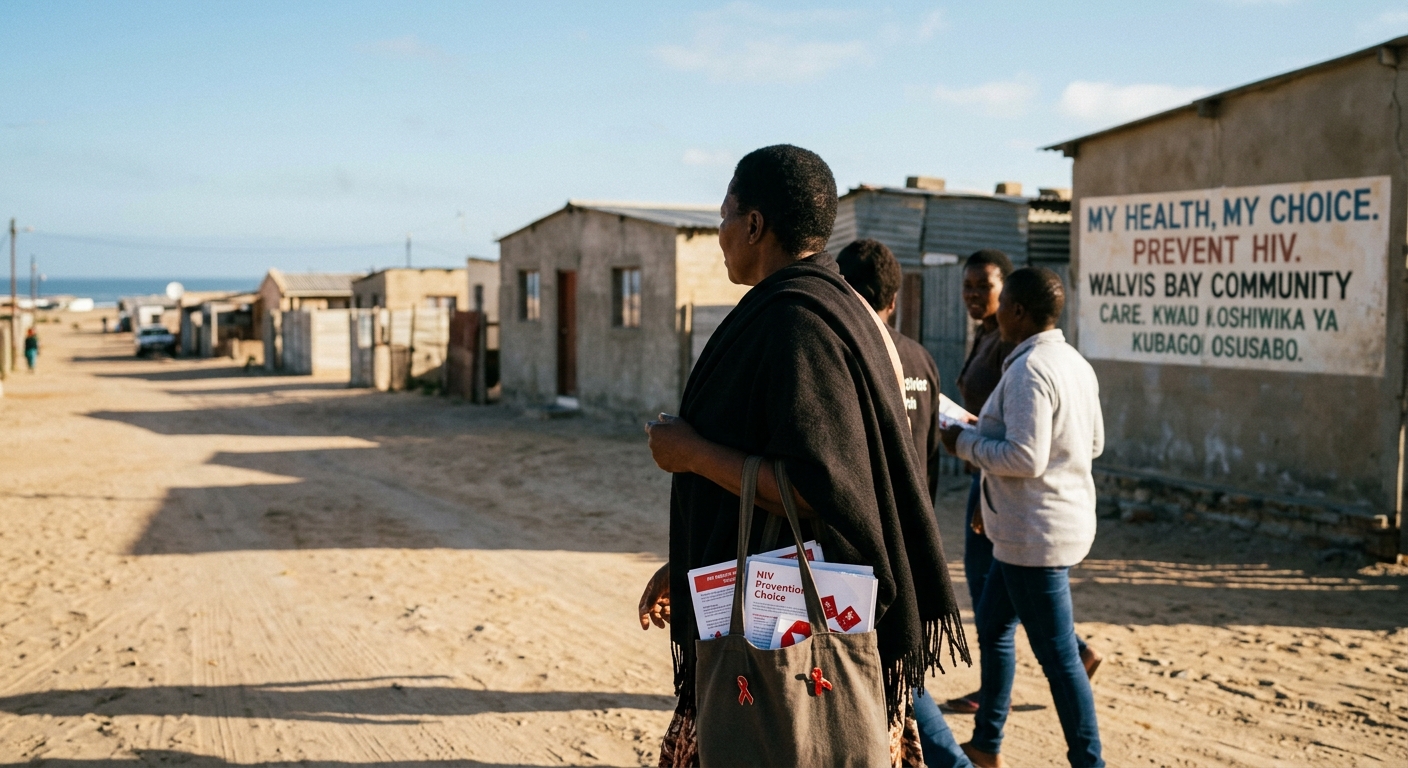
For more than three decades, Esther* has lived and worked as a sex worker in Namibia. For more than 25 years, she has also been a sex worker-rights and human-rights community activist, dedicating her life to strengthening the rights, health, dignity and safety of sex workers and other marginalized communities.
Her journey has given her a unique perspective — one shaped both by lived experience and by many years of working alongside sex workers and community organizations.
“My work has focused on strengthening the rights, health, dignity and safety of sex workers and other marginalized communities.”
Over the years, Esther has worked closely with sex workers at community level, particularly around HIV prevention, treatment literacy, human rights, community-led monitoring, access to health services, advocacy and policy engagement.
When it comes to HIV prevention, she knows that sex workers have several options available, including condoms, PrEP, PEP, regular HIV testing, treatment as prevention for people living with HIV, and combination prevention approaches.
But for Esther, having options listed on paper is not the same as having a real choice.
“The important issue is that availability on paper does not necessarily equal meaningful choice.”
A prevention method, she explains, must be accessible, affordable or free, acceptable, confidential and compatible with someone’s actual life.
Choice Must Be Real
Esther believes sex workers should have genuine choice rather than theoretical choice.
“Choice means having multiple methods and being able to select the one that works best for your body, work, relationships and circumstances.”
She recalls situations where the prevention option she preferred was not immediately accessible because of stock availability, service hours, distance, funding-related disruptions or the need to go through a facility where confidentiality and stigma were concerns.
These experiences reinforced for her that HIV prevention is not simply about whether a method exists.
“It is about whether people can access it at the moment they need it, without judgement or unnecessary barriers.”
There is no single HIV prevention method that Esther believes works best for everyone. Condoms remain extremely important because they protect against HIV and many STIs and can be used at the point of sexual exposure. PrEP provides an additional layer of protection, while PEP is important after potential exposure.
For Esther, the answer lies in combination prevention and, most importantly, real choice.
Looking Toward Long-Acting Prevention
Esther is also aware of newer HIV prevention technologies such as Lenacapavir, which she sees as particularly exciting because it offers a twice-yearly injectable PrEP option.
For sex workers, she believes such an option could potentially address some of the challenges associated with daily pills, including privacy, adherence, stigma and frequent clinic visits.
But innovation alone is not enough.
“Approval is not the same as access in Namibia.”
For Esther, the critical question is when and how such innovations will become accessible, affordable and equitably available to sex workers and other populations who could benefit from them.
When Funding Cuts Limit Choice
Recent funding reductions have also affected the practical choices available to sex workers.
When outreach programmes, peer educators and community distribution systems are reduced, people may technically still have access to services through the health system. However, those services can become less convenient and less responsive to the realities of sex workers’ lives.
Esther identifies stock-outs, distance to services, clinic opening hours, stigma, discrimination, confidentiality concerns, transport costs, limited information and the availability of only certain methods as some of the barriers sex workers face.
There are also social barriers.
A person may want to use PrEP but worry that a partner or client will interpret the medication as evidence that they have HIV or are sexually active.
“This is why prevention technologies need to be accompanied by choice, confidentiality and community education.”
A Full Prevention Toolbox
If she had full freedom to choose, Esther would want access to a complete prevention toolbox — condoms and lubricants, oral PrEP, injectable PrEP, PEP, regular HIV testing, STI services and new long-acting technologies such as lenacapavir as they become available and appropriate.
But access alone is not enough.
She wants these options to be available through friendly, confidential and accessible services, including community and peer-led delivery.
Her message to policymakers is clear: sex workers must be recognized not only as beneficiaries of HIV programmes, but as partners, service providers, advocates and decision-makers.
“We cannot build a sustainable HIV response by removing the communities that make the response work.”
And at the heart of Esther’s message is a simple principle — HIV prevention is a right, not a privilege.
“Sex workers should not be given one option and told to make it work.”
She is calling for a range of scientifically proven prevention choices and the freedom to select the method that fits each person’s body, work, relationships and life.
“We need a range of scientifically proven prevention choices and the freedom to select the method that fits our bodies, our work, our relationships and our lives.”