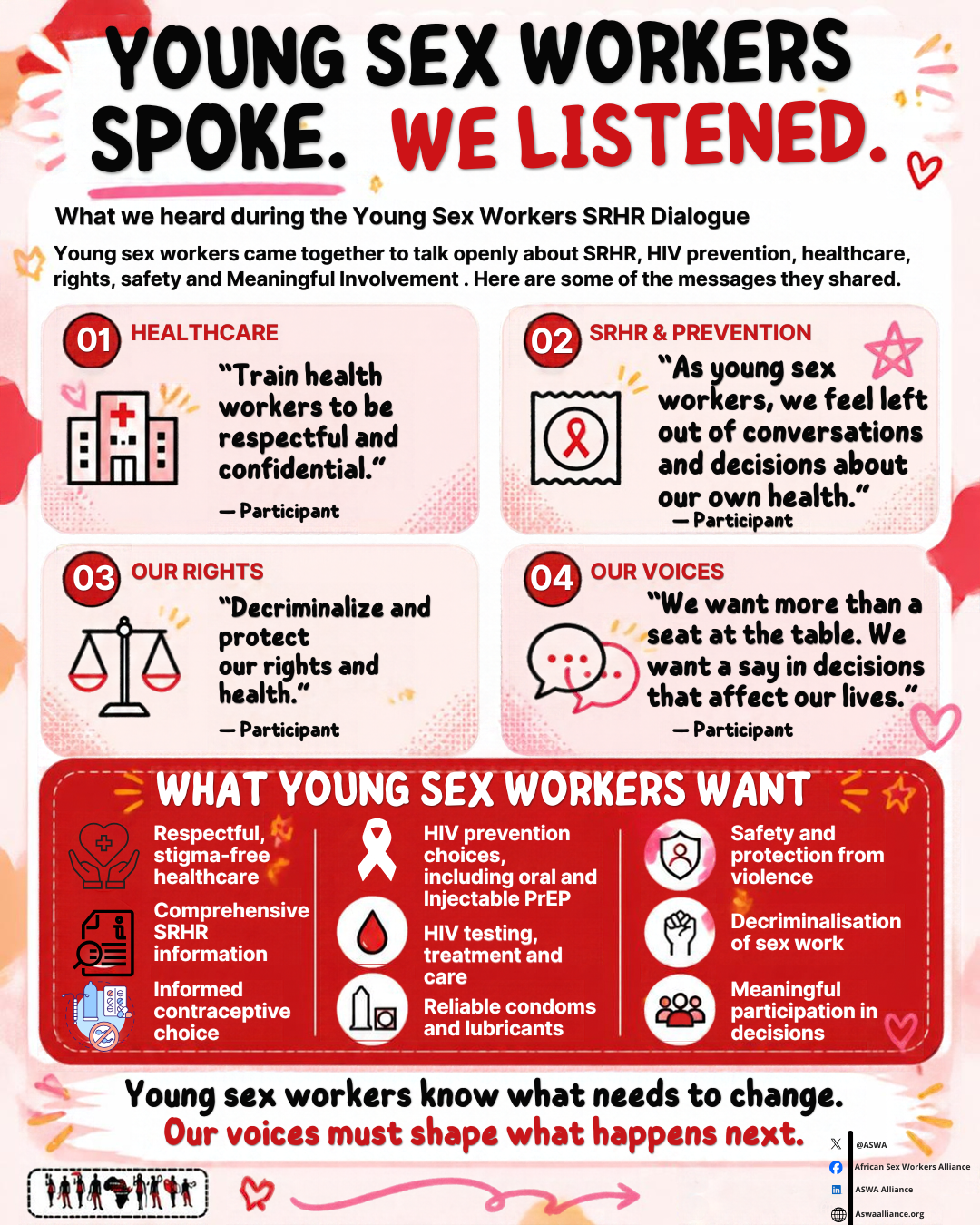
From stigma in healthcare facilities to limited prevention choices and exclusion from decision-making, young African sex workers are calling for services that recognise their needs, respect their choices and listen to their voices.
What does access to healthcare really mean when the people who need it are afraid of being judged, cannot afford the services or are excluded from decisions about their own health?
This question was at the heart of discussions during the Young Sex Workers Sexual and Reproductive Health and Rights (SRHR) Dialogue convened by the African Sex Workers Alliance (ASWA) on 2 October 2026.
The dialogue brought together young African sex workers to share their experiences of accessing healthcare, HIV prevention, contraception and other sexual and reproductive health services. It also provided an opportunity to discuss stigma, discrimination, safety, human rights and the importance of having a voice in decisions that affect our lives.
As participants shared their experiences, one issue became increasingly clear: the existence of healthcare services does not necessarily mean that young sex workers can access them.
When seeking healthcare comes with fear of judgement
For many young sex workers, accessing healthcare involves more than finding a nearby clinic.
Participants described health facilities that are difficult to reach, services that are expensive and opening hours that do not always accommodate their working schedules.
As one participant explained:
“Clinics that are far, expensive or only open when we are working.”
Beyond these practical barriers, the discussion revealed another concern: how young sex workers are treated when they seek care.
“Train health workers to be respectful and confidential.”
Participants spoke about the judgement and discrimination young sex workers experience because of their work and age. They emphasised the need for healthcare providers to create environments where everyone can seek services without fear of being insulted, exposed or treated differently.
When confidentiality cannot be trusted or discrimination is expected, seeking healthcare can become a difficult decision.
Healthcare should not require us to choose between protecting our dignity and protecting our health.
We need information, but we also need choices
Access to comprehensive sexual and reproductive health information emerged as another important concern.
Participants expressed the need for more information on HIV prevention, including injectable pre-exposure prophylaxis (PrEP), as well as the prevention and treatment of sexually transmitted infections (STIs).
One participant highlighted the information gaps affecting young sex workers:
“More information on injectable PrEP and more information about prevention and treatment of STIs and HIV… as young sex workers we feel left out.”
The discussion reinforced the importance of ensuring that young sex workers are informed about available prevention options and supported to make decisions based on their individual needs.
Contraception was another important part of the wider SRHR conversation.
Access to contraceptive services should also mean receiving accurate information about different methods, understanding their benefits and possible side effects, and being able to make informed choices without pressure or judgement.
For young sex workers, sexual and reproductive healthcare must go beyond HIV prevention alone.
Our health needs also include contraception, STI services, reproductive healthcare, safety and the freedom to make informed decisions about our own bodies.
As another participant emphasised:
“It’s important to know your rights to make decisions on your own body.”
We need more than services that tell us what is available. We need information and choices that allow us to decide what works for us.
A condom may be available, but is it reaching the community?
The dialogue also highlighted differences in access to condoms and other prevention commodities across communities.
Participants from Zambia shared experiences of varying condom availability between locations, while a participant from Burundi explained that although condoms could be found in hospitals and pharmacies and distributed by peer educators, they did not always reach community members who needed them.
Reflecting on the situation in Burundi, one participant shared:
“For Burundi, condoms are found [in] the hospitals and pharmacy… peer educators usually distribute them to their community but most of the time we don’t get them.”
These experiences raised concerns about the gap between the availability of prevention commodities and their accessibility within communities.
They also highlighted why prevention programmes must consider the realities young sex workers face, including financial pressures, inconsistent supplies and challenges in negotiating safer sex.
Making condoms and lubricants available is important. Ensuring that they consistently reach young sex workers is equally important.
We want our voices to influence decisions
One of the strongest messages from the dialogue concerned the exclusion of young sex workers from conversations and decisions about their own health.
Participants questioned what meaningful involvement looks like when young sex workers are invited into spaces but have limited opportunities to influence the programmes and policies being discussed.
One participant expressed concern about the limited opportunities young sex workers have to share their experiences:
“Young sex workers are not given an opportunity to express themselves [and] how they feel.”
Another participant emphasised the importance of moving beyond simply being present to having an active role in discussions and decisions.
Their contributions reflected a wider issue: being present does not always mean being heard.
Young sex workers have direct experience of the challenges affecting our communities. We understand the barriers to accessing healthcare, the realities of negotiating safety and the gaps that exist in prevention information and services.
That knowledge should not be overlooked.
We are not simply recipients of services. Across our communities, young sex workers are already organising, educating peers, advocating for rights and supporting one another.
Our involvement should extend beyond attending meetings or sharing experiences. We should have opportunities to contribute to programme design, implementation, monitoring and evaluation.
Our voices should not only be welcomed in conversations. They should influence the decisions that follow.
Our health and rights cannot be separated
The discussion also highlighted how stigma, discrimination and restrictive laws affect the safety and wellbeing of young sex workers.
For participants, access to healthcare was closely connected to the protection of their human rights.
One participant called for:
“Decriminalize and protect our right and health.”
Another participant identified three connected priorities:
“Health, safety and human rights.”
These contributions reflected the importance of addressing the conditions that prevent young sex workers from living safely and accessing services without fear.
Participants also called for safe and respectful healthcare, protection from violence, access to information about their rights and spaces where they could speak openly about their experiences.
Protecting our health requires more than medical services alone. It also requires addressing the stigma, discrimination and policy barriers that affect our everyday lives.
Beyond the dialogue: What needs to change?
The experiences shared during the session pointed to several priorities.
Young sex workers need healthcare that is respectful, confidential, affordable and accessible. We need comprehensive SRHR information, informed contraceptive choices, access to different HIV prevention options and reliable supplies of condoms and lubricants.
We also need protection from violence and discrimination, policies that uphold our rights and opportunities to influence decisions affecting our health and lives.
Feedback shared after the dialogue reinforced the importance of continuing these conversations. Participants recognised the need for more spaces where young sex workers can ask questions, exchange information, learn from one another and strengthen their understanding of their rights and available services.
These conversations also need to reach beyond those who attended the session, so that information and learning can be shared within our wider communities.
For ASWA, the experiences and priorities raised during the dialogue provide an important basis for continued engagement with young sex workers, member organisations, healthcare providers, policymakers and partners.
But listening must be followed by accountability.
How will the concerns raised influence future programmes? How will young sex workers know whether their recommendations have been considered? And how can their involvement continue beyond a single dialogue?
These are questions that deserve continued attention.
The conversation cannot end here
The Young Sex Workers SRHR Dialogue was more than an opportunity to discuss healthcare challenges. It was a reminder that young African sex workers have valuable knowledge, experiences and ideas about what needs to change.
Our experiences are not simply stories to be documented. They are evidence of the barriers we face and the changes our communities are calling for.
When young sex workers speak about discrimination in healthcare, limited prevention choices or exclusion from decision-making, we are identifying issues that deserve attention from the people and institutions responsible for protecting our health and rights.
The challenge now is to ensure that these conversations contribute to meaningful improvements in services, programmes and policies.
Young African sex workers have spoken. We have identified the gaps, shared our experiences and expressed what we need.
The next step is ensuring that our voices are not only heard, but reflected in the decisions that shape our health, rights and futures.
African Sex Workers Alliance (ASWA)
October 2026