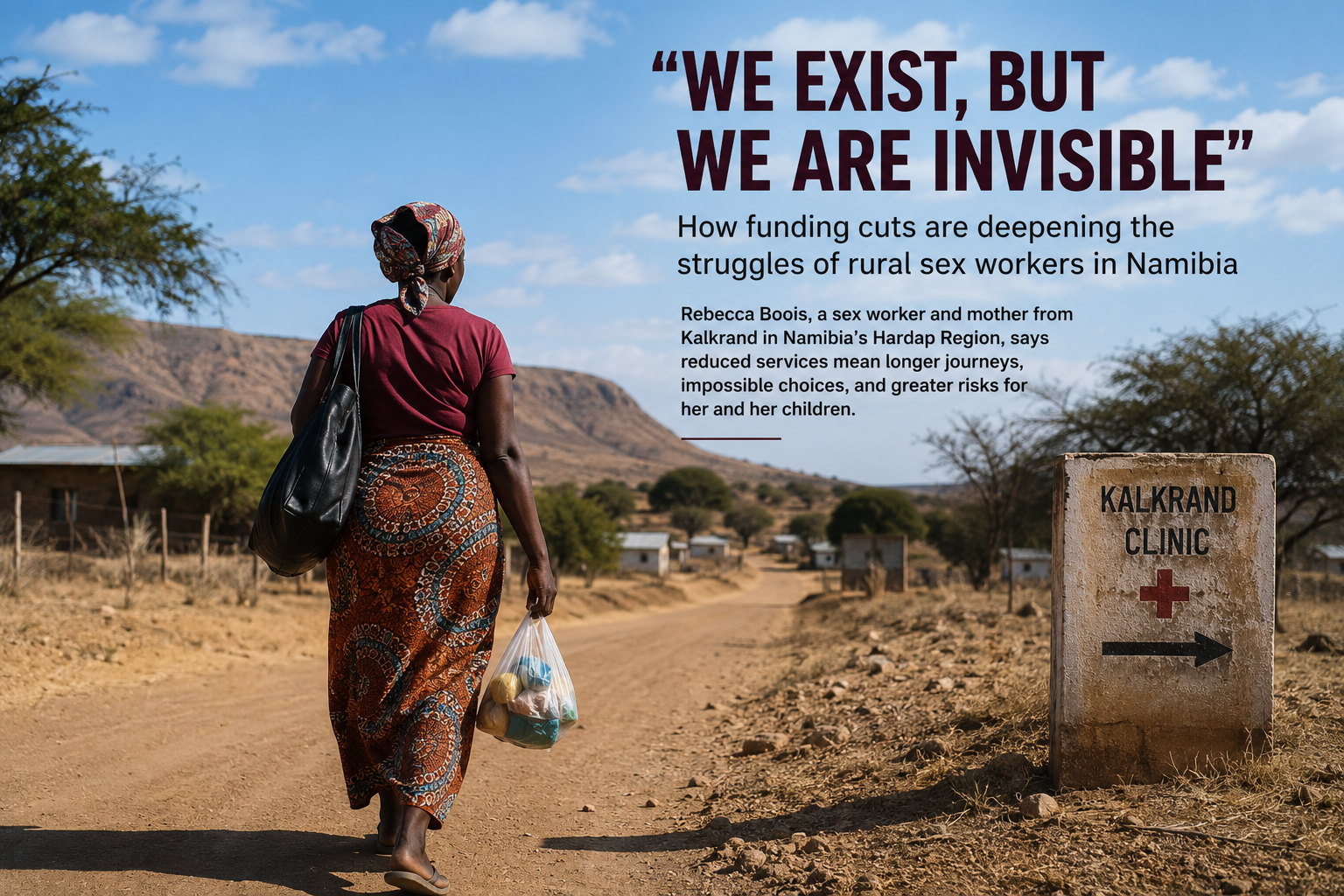
For Rebecca Boois, the effects of the United States foreign aid suspension and Stop Work Order are not measured in policy statements or donor reports. They are felt in the daily struggle to access healthcare, provide for her children, and survive in a rural community where support services are disappearing.
“My name is Rebecca Boois, a sex worker from Kalkrand in Hardap Region, Namibia. I am a mother and I do sex work to survive and take care of my children,” she says. “Life in a small rural town is not easy, and opportunities for work are very limited, so I depend on this work to meet basic needs like food, school needs, and rent.”
Rebecca lives in Kalkrand, a small settlement in Namibia’s Hardap Region, where sex work remains largely hidden and support services are scarce. Like many rural sex workers, she has long relied on public healthcare facilities and occasional outreach programmes to access HIV prevention, treatment and information.
Before funding reductions affected HIV and community-based programmes across Africa, life was already difficult. However, there were at least some outreach services that reached remote communities.
“Before funding reductions in broader national programmes, life was still difficult, but there were at least some outreach services that reached nearby towns or mobile clinics that occasionally included us,” Rebecca recalls.
Today, those services are becoming increasingly difficult to find.
“We have experienced reduced outreach, fewer prevention messages, less distribution of condoms and lubricants, and less visibility of support organizations in rural areas like ours. This has increased isolation among sex workers.”
Rebecca’s experience reflects a much larger crisis unfolding across Africa. According to an assessment conducted by the African Sex Workers Alliance (ASWA), the suspension of US foreign aid and implementation of the Stop Work Order has affected more than 106,000 sex workers across 19 African countries. The assessment found that 89 percent of surveyed sex worker-led organizations experienced significant disruptions, while34 of the 38 organizations surveyed were directly dependent on PEPFAR, USAID or CDC funding streams.
For communities that were already underserved, the funding suspension has had immediate consequences. ASWA documented the closure of drop-in centres and outreach programmes, reduced supplies of condoms and lubricants, interruptions in HIV services, and job losses among staff and volunteers. The report also found growing anxiety and depression among sex workers who feared losing access to healthcare and livelihoods.
For sex workers living with HIV, the consequences can be life-threatening.
Namibia has one of the highest HIV prevalence rates in the world, with approximately 190,000 people living with HIV. Female sex workers remain disproportionately affected by the epidemic and often face additional barriers to treatment because of stigma and discrimination.
“For sex workers living with HIV, the journey has been difficult because we use the same public clinics as everyone else, where stigma is still present,” Rebecca explains. “Some health workers are supportive, but others judge us when they know our situation.”
Fear of discrimination often prevents sex workers from seeking healthcare early.
“Many of us only go when we are very sick or when we have no other choice, which affects early treatment and consistent care.”
The ASWA assessment found that four out of every ten sex workers affected by the Stop Work Order rely on antiretroviral treatment (ART). It further estimated that 45,061 sex workers were left at risk of losing access to life-saving HIV medication for every day the funding pause continued.
In Kalkrand, reduced outreach services mean sex workers must travel long distances to access care.
“We now rely almost entirely on public clinics in Rehoboth or surrounding towns, which require transport money that we do not always have.”
Without money for transport, treatment can be delayed.
“These changes have made it harder for some sex workers to maintain regular clinic visits or collect medication on time. When there is no transport money or when we fear being judged, some of us delay going to the clinic, which affects adherence and overall health.”
The impact extends beyond healthcare.
Because services are now farther away, sex workers must spend more of their limited income on transport and health-related costs.
“Because services are harder to reach, we spend more money on transport and health needs. This reduces what is left for food, school needs, and basic household support.”
For Rebecca and many other mothers, this creates impossible choices.
“Sometimes we have to choose between buying food, paying transport, or meeting school needs. These are very difficult decisions that affect our children’s stability.”
Children often bear the hidden cost of funding cuts.
“When income is not stable, it becomes difficult to consistently provide food, school supplies, or transport. This affects their school attendance and wellbeing.”
The reduction in funding has also weakened community support systems that many sex workers relied upon for information and protection.
“The community is more disconnected now. In a rural place like Kalkrand, where people already hide their work, isolation has increased. There is less sharing of information and more fear.”
Peer educators and outreach workers previously served as trusted sources of health information and referrals. Their reduced presence has left many women feeling abandoned.
“Community outreach services and mobile health services have become less frequent. Peer educator support is also less available. Everything now depends on travelling to public health facilities.”
The effects are equally visible in HIV prevention.
When asked what HIV prevention options are available in Kalkrand, Rebecca’s response reveals a stark contrast between the growing range of HIV prevention technologies available globally and the limited choices available to many rural sex workers.
“I will be honest in Kalkrand there’s no real choice. We have to appreciate what the Ministry has and utilize the available commodities.”
Even basic prevention tools are not always available.
“I needed condoms and it is always out of stock.”
Rebecca says many sex workers in her community have little information about newer HIV prevention options and often rely on whatever services or commodities happen to be available.
Her experience highlights a challenge increasingly raised by HIV prevention advocates across Africa: the issue is not only access, but choice.
While HIV prevention methods now include Oral PrEP, the Dapivirine Vaginal Ring, injectable Cabotegravir and the newly introduced six-monthly injectable Lenacapavir, many rural sex workers remain excluded from information and access to these options.
As HIV prevention expert Nicolette Naidoo recently noted, “Choice is not only about access to products; it is about empowering people to make informed decisions about their own health.”
For Rebecca, that choice remains out of reach. The reduction of outreach services and community-based programmes following the funding suspension has left many rural sex workers with fewer opportunities to access prevention information, fewer commodities, and fewer options to choose the HIV prevention method that best fits their lives and circumstances.
Despite the growing challenges, Rebecca says sex workers continue to support one another through informal networks.
“We cope through resilience and supporting each other informally. We share small resources, information, and emotional support.”
With no formal sex worker-specific support systems in Kalkrand, these relationships have become essential for survival.
“There are no formal sex worker-specific systems in Kalkrand. We rely mainly on each other and occasional public health services.”
What keeps them going, she says, is the responsibility they carry for their families.
“Our children and survival need keep us going. We also hope that conditions will improve and that we will eventually receive more dignity and support.”
As governments and donors debate the future of global health funding, Rebecca wants decision-makers to remember communities that rarely appear in reports and funding discussions.
“Do not forget rural sex workers like us in Kalkrand. We exist, but we are invisible in programmes. Bring services closer to us, remove stigma in healthcare, and ensure we are included in planning decisions that affect our lives.”
Rebecca’s story illustrates the human cost of funding decisions made thousands of kilometres away. For sex workers in rural Namibia, the effects of the Stop Work Order are not abstract policy consequences. They are longer journeys to clinics, empty shelves where condoms should be, missed treatment appointments, increased financial hardship, and children whose wellbeing is threatened by growing instability.
The ASWA assessment shows that more than 106,000 sex workers across Africa are facing similar challenges. Behind every statistic is a person like Rebecca, a mother, a caregiver, a worker, doing everything possible to survive while essential support systems disappear around her.