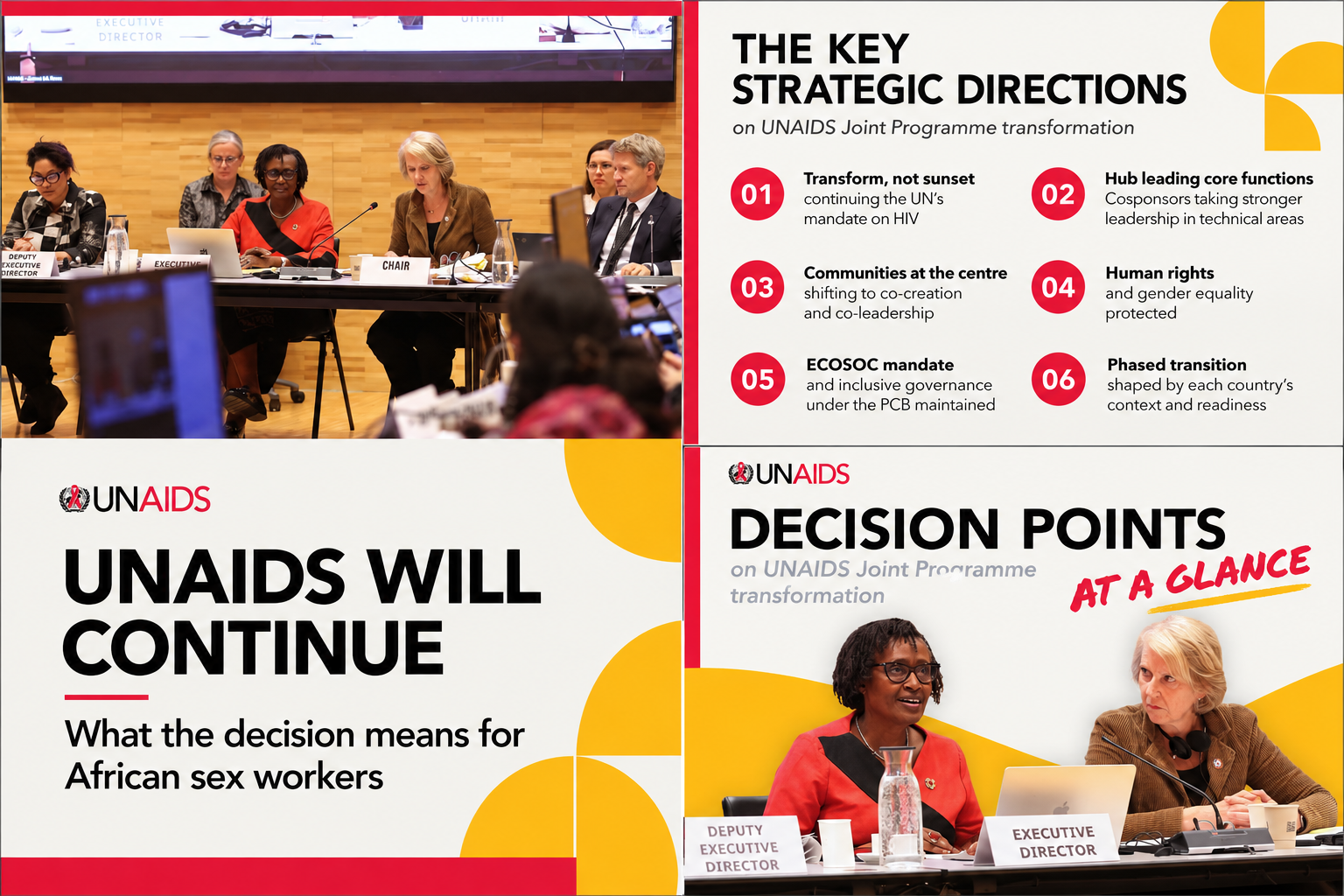
Photo Credit: UNAIDS
The decision to preserve UNAIDS marks an important moment for the global HIV response, particularly for communities that continue to face barriers to HIV prevention, treatment and care.
On 26 October 2026, the UNAIDS Programme Coordinating Board (PCB) rejected the proposed phasing out of the Joint United Nations Programme on HIV/AIDS, choosing instead to transform and strengthen its operations.
The decision comes at a critical time when funding cuts, shrinking civic space, stigma, discrimination and criminalisation threaten progress in the HIV response.
For African sex workers, the future of UNAIDS is not simply about preserving a United Nations institution. It is about ensuring that the global HIV response continues to recognise our rights, support community-led organisations and address the inequalities that prevent us from accessing healthcare.
Speaking following the decision, UNAIDS Executive Director Winnie Byanyima emphasised that preserving the programme was only the beginning:
“Saving the Joint Programme is only the beginning.”
Her message reflects the challenge ahead: ensuring that the transformation strengthens rather than weakens the systems and services that communities depend on.
What Did the UNAIDS Board Decide?
At its special session, the Board reaffirmed its support for a continued, more focused and efficient UNAIDS Joint Programme, with greater emphasis on country-level responses and community leadership.
The agreed strategic direction includes:
- Maintaining UNAIDS and the United Nations’ mandate on HIV.
- Strengthening community participation through co-creation and co-leadership.
- Protecting human rights and gender equality within the HIV response.
- Giving UNAIDS cosponsoring organisations greater technical leadership in their respective areas.
- Maintaining inclusive governance through the Programme Coordinating Board.
- Introducing changes gradually, based on countries’ circumstances, capacities and readiness.
Importantly, the Board agreed that communities must remain at the centre of the transformed programme.
United Nations Deputy Secretary-General Amina Mohammed also emphasised the importance of preserving the HIV response while strengthening its delivery at country level.
The direction is clear: transformation should improve how the global HIV response serves people, rather than simply reduce institutional structures.
Why This Matters for African Sex Workers
Across Africa, sex workers continue to face significant challenges in accessing HIV prevention, testing, treatment and care.
Criminalisation, violence, discrimination and stigma within healthcare settings can discourage people from seeking essential services. These barriers are particularly concerning for communities already experiencing exclusion from mainstream health systems.
For years, sex worker-led organisations have worked to bridge these gaps through peer education, community outreach, HIV prevention information, referrals, violence documentation and human rights advocacy.
These efforts are essential to ensuring that HIV services reach communities that might otherwise be left behind.
UNAIDS has played an important role in promoting human rights-based HIV responses and recognising the meaningful participation of key populations.
Its continuation provides an opportunity to protect these commitments at a time when reductions in HIV funding threaten the sustainability of community-led services.
However, preserving UNAIDS alone is not enough.
The transformation must strengthen support for organisations working directly with communities, particularly in countries where sex work remains criminalised and access to healthcare is restricted by stigma and discrimination.
For African sex workers, progress must be measured by what changes in our everyday lives: whether we can access HIV prevention without discrimination, receive treatment without fear and participate in decisions that affect our health.
Community Leadership Must Go Beyond Consultation
One of the most significant commitments in the Board’s decision is the shift towards community co-creation and co-leadership.
This is particularly important for sex worker-led organisations that have consistently advocated for meaningful involvement in the design and implementation of HIV programmes.
For us, meaningful participation must go beyond being invited to meetings or consulted after decisions have already been made.
We must be involved in setting priorities, designing programmes, allocating resources and monitoring how HIV interventions are implemented.
As UNAIDS develops its transition plan, sex worker-led organisations must have meaningful opportunities to contribute to decisions that will affect our communities.
The Board has requested the establishment of a Transition Task Team, bringing together representatives of the UNAIDS Secretariat, cosponsoring organisations and two community representatives nominated by the PCB NGO delegation.
This provides an important opportunity for community involvement in the transformation process.
However, representation at the global level must also be accompanied by meaningful engagement with communities at regional and country levels.
African sex workers must not be left out of discussions about how HIV programmes are funded, coordinated and delivered in our countries.
Our participation must influence decisions, not simply demonstrate that consultation took place.
Funding Remains a Major Concern
Although the Board’s decision provides reassurance about the continuation of UNAIDS, financial uncertainty remains a serious challenge.
Across the HIV response, funding reductions are placing pressure on prevention programmes, community outreach and services that support populations most affected by HIV.
The Board approved the 2027 Work Plan and Budget and encouraged governments to make timely contributions and longer-term financial commitments.
Several countries, including Algeria, Benin, Côte d’Ivoire and South Africa, have already contributed to supporting UNAIDS.
Algeria also announced an early voluntary contribution of US$40,000 towards the UNAIDS country office in Algiers for 2027.
These commitments demonstrate the importance of continued investment in the HIV response.
For sex worker-led organisations, sustainable funding is essential to maintaining peer-led HIV prevention, community outreach, referrals, violence documentation and human rights advocacy.
Funding reductions must not result in the closure or weakening of services that our communities depend on.
We also need continued investment in newer HIV prevention technologies, including long-acting prevention options, alongside condoms, oral PrEP and other existing prevention methods.
Expanding prevention choices is important, but these innovations must be affordable, accessible and responsive to the realities of our communities.
Leadership Transition: What Comes Next for UNAIDS?
Alongside the Board’s decision, Winnie Byanyima announced that she will complete her service as UNAIDS Executive Director on 31 December 2026.
The United Nations Secretary-General is expected to appoint an interim Executive Director from 1 January 2027 while the selection process for a new Executive Director begins.
This leadership transition will take place as UNAIDS prepares to implement its new operating model.
For communities most affected by HIV, continuity in leadership, accountability and engagement will be essential.
The transition must safeguard existing commitments to human rights, gender equality and community-led responses while ensuring that the voices of key populations remain central to the programme’s future.
The coming months will therefore be important in determining how the Board’s commitments translate into practical changes at global, regional and country levels.
Our Call as African Sex Workers
At the African Sex Workers Alliance (ASWA), we recognise the importance of a strong, accountable and human rights-based global HIV response.
The decision to continue UNAIDS creates an opportunity to strengthen the role of communities in shaping the future of HIV prevention, treatment and care.
As the programme enters this new phase, we call for meaningful inclusion of sex worker-led organisations in the transformation process, sustained investment in community-led HIV services and continued protection of human rights and gender equality.
We also call for HIV programmes that recognise the diverse needs of our communities, including greater access to newer prevention technologies, comprehensive healthcare and a range of prevention choices.
The transformation of UNAIDS must not weaken the community-led organisations that have worked for decades to reach people who face exclusion from healthcare systems.
Instead, it must recognise our expertise, invest in our leadership and strengthen our ability to respond to the needs of our communities.
The future of UNAIDS must be measured not only by how efficiently it operates, but by whether the communities most affected by HIV can access the services, protection and support they need.
For African sex workers, our message remains clear:
Decisions about our health must never be made without us.
Source: UNAIDS, UNAIDS Board Rejects Sunsetting of UNAIDS, 26 October 2026.