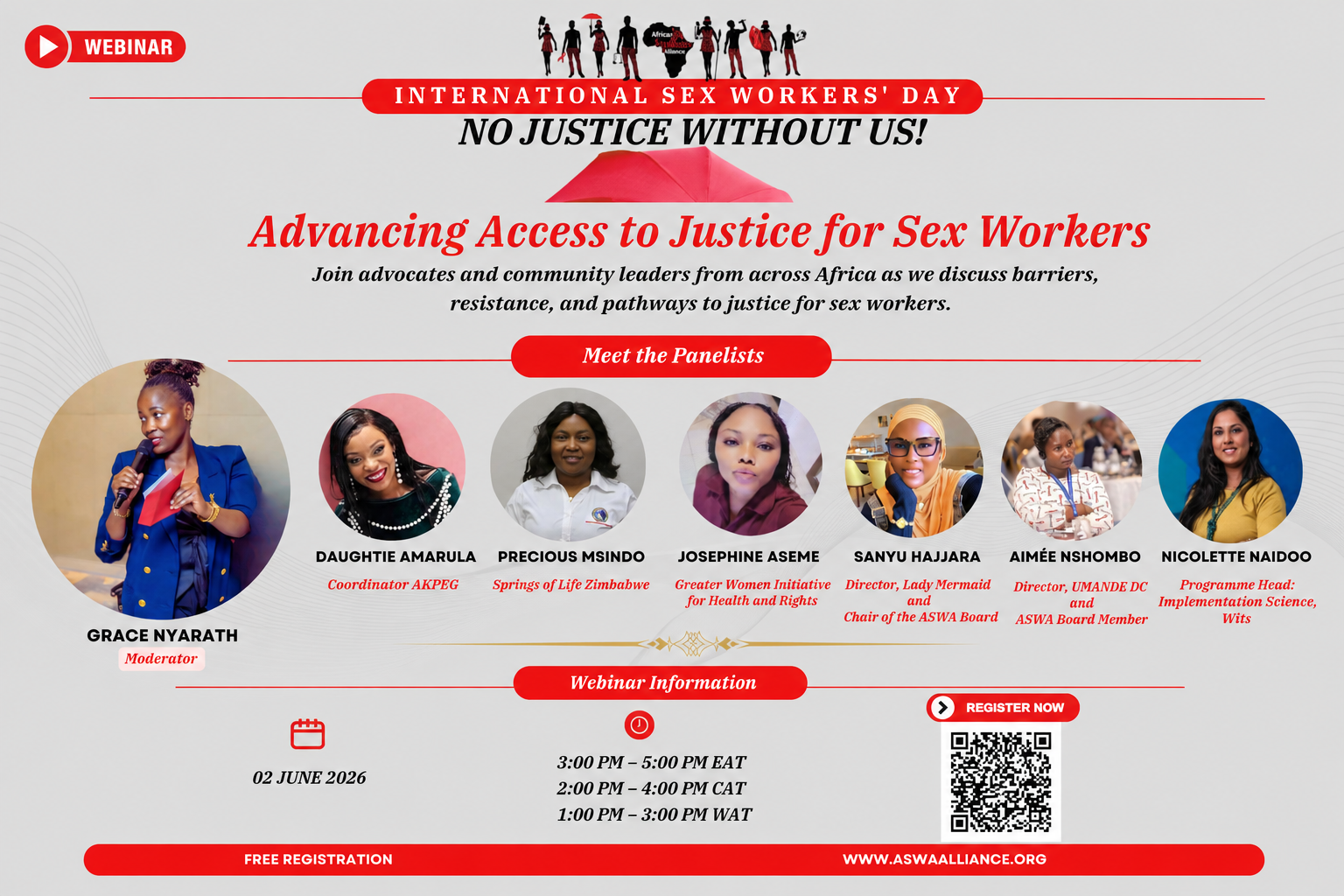
African Sex Workers Alliance (ASWA) commemorated International Sex Workers’ Day with a webinar that brought together sex workers, advocates, researchers, and partners to discuss access to justice, health rights, and the importance of meaningful inclusion in HIV prevention efforts.
Held under the global theme “Access to Justice,” the webinar provided a platform to reflect on the ongoing challenges sex workers face in accessing healthcare, legal protection, and justice, while also highlighting emerging opportunities in HIV prevention.
Speaking during the webinar, Nicolette Naidoo, Programme Head: Implementation Science at Wits RHI, emphasized the critical role of choice in HIV prevention and called on sex workers to continue advocating for equitable access to a growing range of HIV prevention options.
Naidoo highlighted that Africa is at a pivotal moment in HIV prevention with the introduction of Lenacapavir, a six-monthly injectable HIV prevention product that is being rolled out across several African countries. She noted that Eswatini and Zambia became the first countries to introduce the product in the public health sector, followed by other countries including Kenya, Uganda, Zimbabwe, Lesotho, Mozambique, Nigeria, South Africa, and Zambia.
“The more options people have, the more likely they are to find a prevention method that works for their lifestyle and circumstances,” Naidoo said. “Choice is not only about access to products; it is about empowering people to make informed decisions about their own health.”
She explained that HIV prevention methods now include Oral PrEP, the Dapivirine Vaginal Ring, the two-monthly injectable Cabotegravir, and the six-monthly injectable Lenacapavir explaining that research has shown that when multiple options are available, uptake and overall coverage of HIV prevention programmes improve significantly.
Naidoo noted that factors such as convenience, efficacy, discretion, and individual preferences influence which prevention methods people choose. For many users, particularly female sex workers and adolescent girls and young women, longer-acting and more discreet options have proven highly attractive.
Addressing the role of sex workers in advancing HIV prevention access, Naidoo called for stronger advocacy centered on prevention choice rather than promoting a single method.
“We must ensure that our messaging is about choice. It is not about one product over another, but about ensuring that individuals can select the method that best meets their needs,” she said.
She further underscored the importance of community-led monitoring, urging sex worker communities and civil society organisations to continue documenting and reporting barriers to healthcare access, stigma, discrimination, and service delivery challenges.
According to Naidoo, community voices remain essential in shaping policies, guidelines, and programmes that respond to the realities faced by sex workers and other key populations.
She also commended ASWA for ensuring that sex workers are represented at grassroots, national, regional, and global decision-making platforms.
Speaking during the webinar, Sanyu Hajjara Batte, Executive Director of Lady Mermaid, highlighted the legal and structural barriers that continue to deny sex workers access to justice across East Africa.
Hajar noted that while many countries have constitutions and human rights frameworks that guarantee equal rights and protection under the law, sex workers often face significant challenges in claiming those rights due to criminalization, stigma, and discrimination.
“There is a contradiction where sex workers are expected to seek justice through systems that often criminalize and marginalize them,” she said. “While justice should be available to everyone, many sex workers face barriers that prevent them from accessing legal protection and remedies when their rights are violated.”
She further explained that laws related to sex work in countries across East Africa, including Kenya, Uganda, Tanzania, and South Sudan, continue to create hostile environments for sex workers. Hajar emphasized that the impact of criminalization is compounded by laws targeting LGBTQ+ communities, as sex work intersects with diverse sexual orientations and gender identities.
“Our movement includes female sex workers, lesbian sex workers, transgender sex workers, and male sex workers,” she said. “Laws that criminalize or discriminate against LGBTQ+ people directly affect many sex workers because our communities are interconnected.”
Hajar called for the removal of legal and social barriers that expose sex workers to violence, discrimination, and exclusion from essential services, stressing that meaningful access to justice can only be achieved when all people are able to exercise their rights without fear of arrest, stigma, or persecution.
Contributing to the discussion, Frazer Mpofu from the Zimbabwe Sex Workers Alliance (ZIMSWA) emphasized the importance of strengthening access to quality healthcare services for sex workers across Africa.
Mpofu noted that improving health outcomes for sex workers requires addressing the stigma and discrimination that many continue to experience within healthcare settings. He called for greater investment in community-led and peer-driven approaches that are responsive to the realities and needs of sex worker communities.
“Strengthening access to care for sex workers requires the removal of stigma and discrimination within health facilities, the expansion of community-led and peer-driven services, and the integration of comprehensive sexual and reproductive health, HIV, TB, mental health, and gender-based violence support services,” he said.
He urged governments, donors, and healthcare providers to invest in sex worker-friendly services, strengthen healthcare worker training on human rights and key population sensitivity, support mobile and outreach clinics, and ensure the meaningful participation of sex workers in the design, implementation, and monitoring of health programmes.
According to Mpofu, creating safe, accessible, affordable, and non-judgmental healthcare environments is essential to ensuring that sex workers can access timely prevention, treatment, care, and support services. He added that such efforts would contribute significantly to improved health outcomes and the advancement of health equity for sex worker communities.
International Sex Workers’ Day is commemorated annually on 2 June in remembrance of the 1975 occupation of Saint-Nizier Church in Lyon, France, where more than 100 sex workers protested violence, criminalisation, police harassment, and poor working conditions.
This year’s theme, “Access to Justice,” highlights the urgent need to address legal barriers, violence, impunity, and discrimination faced by sex workers while advancing access to healthcare, legal protection, and human rights. Advocates continue to call for the decriminalisation of sex work, arguing that punitive laws increase vulnerability to violence and create barriers to essential services and justice systems.